Saturday, 2 July 2011

Himalayan High Day 1

There’s nothing quite like being surrounded by mountains on all sides , and, not just any mountains—the  Himalayas! It’s an awesome feeling standing in a valley and having the Annapurna range all around you, but that feeling comes after a lot of hard work. So, it’s breathtaking to see and breathtaking to get too.

I'll admit, I was intimidated by the thought of trekking through the Himalayas. Was I ready to hike up and down trails, stone staircases and the switchbacks described in the guidebook? In spite of the author’s insistence that you didn’t need to be an Olympic athlete to trek in Nepal, I certainly didn’t agree. However, the thought of my reward, the Annapurna range, abated my fears and got me excited for the adventure. 
 Andrew and I planned on doing the Annapurna Sanctuary trek with a side trip to Poon Hill. This trek typically takes about 10-14 days.

Pokhara is a small town in Nepal, but is set-up to help travelers become trekkers. We bought and rented some of the needed gear. We would followed the tried and true method for staying dry and warm: layers. We bought some gortex and fleece pants. We rented winter jackets and sleeping bags. We also stocked up on muesli, granola, nuts and peanut butter to keep us energized. Water purification tabs would reduce costs and minimize our reliance on bottled water. We had all the gear; now we just needed to get to the trail.

On the first day, Andrew and I started our journey in Naya Pul, a small village a short drive from Pokhara. So far the peaks had been hiding but as we drove to Naya Pul they revealed themselves.  I felt it was a good sign, as if the mountains were welcoming us.

Of course, not all welcomes are friendly. The trail from Naya Pul started off gently enough but it gradually became hard. We were walking on a trail and it wasn’t so bad, in fact, the scenery was lovely. The trail followed a stream and meandered through small villages and farms. Then it continued to go through a forest and we occasionally climbed stone staircases. I had trouble deciding if I preferred the stone staircases over the trail. At this point I concluded that the staircases were short and easy to climb and a nice change from the trail.

Four hours later, we started climbing the real Nepali stone staircases. Whereas, the other ones had been ten steps at a time, these ones were about twenty to thirty steps of varying heights, sometimes they would be small and other times they would be a foot high. It was like a giant and dwarf compromised when building the stairs! Our destination for the day was Ulleri at 2100metres. Looking up at the never ending staircases I thought I wouldn’t make it. 

The mountains were letting us know it wouldn't be easy....There must have been thousands of stairs. As I climbed up the last hundred every muscle in my legs burned. My back ached from carrying my bag all day.  But I never felt so relieved to reach a guesthouse when I climbed the last steps to Ulleri. I wasn’t the only person feeling relief, a British fellow we met on the trail asked me as he finished climbing his final steps up to our guesthouse, “Are you as shattered as I am?”. I answered, “Yes. And I’m not sure if I can be put back together!”. We laughed, in spite of the difficult day, we were relieved and happy to be done.

 We had a great time at our first guesthouse, meeting fellow trekkers, many we continued to bump into along the way, eating dal bhat, drinking tea, and, most importantly, recuperating. One day down; ten more to go.

Sunday, 26 June 2011

Indian Food

India is a vibrant land; colours are abundant as are scents and noises. The food can be a tantalizing experience for the palette. Some Indian chefs are culinary alchemists mixing up ten (or more!) herbs and spices to get the perfect masala combination. Having said that, overall I was disappointed with the food in India. Perhaps, I put too much pressure on the country. I thought every bite of butter chicken or naan bread would be otherworldly.  But the truth is, most meals were okay. Just as you find mediocre restaurants and dishes at home, so it goes in India.
Of course, there were some highlights and here they are: Indique in Jodhpur, Vihar in Panjim, Street foods like samosas, bhel puri and puffs, and Tibetan food in Dhramasala, especially making momos with the Tibetan family. Here are some photos and descriptions of the highlights below.


Indique, a pricier option, was worth the expense. The Thali here was generous in portion and flavour.
Going clockwise, starting with the white dish flecked with brown that's yogurt raita,next our sweet is ladoo, two deep-fried balls of rice soaked in rosewater, rice to soak up all the delicious curries, dahl, lentil curry, palak matter, spinach and pea curry, vegetable curry, mutton curry, and, finally, chicken tikka masala. Naan bread and papad, a deep-fried lentil cracker, sits in the middle. This thali was a delicious feast for two!


While in Panjim we ate at Vihar three times and it didn’t disappoint. The thali was delicious, but the masala dosa ,a huge thin and crispy crepe filled with masala potatoes, became my favorite breakfast food. The flaky puri and tasty chickpea curry and coconut chutney were also delicious introductions to South Indian cuisine. 

 The ubiquitous samosa can be found on most streets, bus and train stations. It was a quick and filling snack for when I was on the go. The famous Mumbai snack bhel puri is a tantalizing concoction of several ingredients: tomato, red onion, stewed chickpeas, chutneys all a top a crispy rice cracker. One snack I haven't mentioned are puffs. These tasty snacks have different fillings like chicken, egg or vegetable wrapped in a crispy puff pastry.

Tibetan refugees live alongside Indians in a small town called Dharamasala that sprinkles itself in the Himalayan foothills. I took the opportunity to experience Tibetan culture firsthand at a homestay. I learned from my homestay family that living in the harsh Himalayas requires a talent for making hearty substantial meals out of minimal ingredients. Tibetans have a knack for just that! Not surprisingly, Tibetan food largely consists of soups and stews. They are fond of making handmade noodles and tossing them in a thick broth with meat and vegetables.
I enjoyed eating mutton phisha, a hearty stew with mutton, thin noodles, black ear mushrooms and green onions. At my Tibetan homestay, I learned how to make vegetable momos, Tibetan dumplings. According to my homestay "dad" a good momo is a juicy one!

Monday, 16 May 2011

Desert Adventures

“Go right; follow Julian. I said right Mr. Laoloo, right.” Mr. Laoloo blinks, scratches his nose and continues to ignore me. He chomps on a tree and chews the twigs. He does this often. He chews almost as much as he farts.  “Mr. Laoloo, we’re behind  and need to catch up. GO RIGHT! Go, come on, you can do it. GO!” Mr. Laoloo continues to chew his twigs. Perhaps he’s deciding the best course of action for us, but I can’t leave it up to him. We’re far behind and Mr. Khan, my guide and camel driver extradonnaire, is telling me to hit him with the rope. “Hit him hard Terri, it’s okay. Give him a little massage with the rope", he says encouragingly.  I hit Mr. Laoloo with the rope. He moves his right rear leg up to scratch his shoulder. I smile. At least he moved. Mr. Khan gives up on me as a camel driver and with a couple clicks of his tongue Mr. Laoloo jerks to life and trots off. Although short-lived, my career as a camel driver was exciting. 

Mr. Laoloo and Papaya, Andrew's camel, with our guides.
Camels are amazing creatures. Come to think of it India has a lot of animals, most mundane than amazing, but they’re not confined to safe and comfortable zones like at home. So interacting with them is interesting and, at times, dangerous, especially on the streets. Besides dodging cars, auto or cycle rickshaws and people, you have to contend with animals.
Having been hit by an autorickshaw and a cow, I can honestly say the cow was scarier. The rickshaw at least attempted to avoid me, but on the narrow streets of Agra it still grazed my arm, shoulder and side. The cow, on the other hand, purposely, and, perhaps with malice, swung its head horn first and jabbed my purse (leather!). The lifesaving  three inch thick copy of Lonely Planet India was the victim of that menace’s horn. Had the book not lied in my purse, unaware of the beating it took, I can only imagine what damage that horn would’ve caused me!
Now, as a general precaution, I dodge dogs, cats, rats, pigs, monkeys, pigeons, and goats. I avoid cows, mules, and horses. Although it’s rare to see them,  I still avoid the working elephants and camels, especially after the incident with the bovine. With a horn in my side, so to speak, it was with some reluctance that I rode on Mr. Laoloo. My reluctance eased once I met him. He was calm, itchy, gassy and, best of all, horn free.

My noble steed: Mr. Laoloo!
 It’s a reasonable assumption that riding a camel will be similar to riding a horse; however, it’s much different. Going up and down on a camel is an interesting experience. To stand up,  the camel uses its front legs, first, left than right. Then, it lifts its hind legs. It is rocky going up and stomach cringing going down. But I got used to it. Although the ride on a camel isn’t as smooth as on a horse, the view is incomparable. From my new nine foot perspective, I saw herds of goats and sheep graze, small deer and mice hide from the sun and acres of scrub land spotted with wind turbines.
The highlight of our Camel Safari was sleeping on the Thali sand dune. We slept underneath the stars and the moon shone so bright that it hardly seemed like night time. The sand peaks looked a brilliant gold in the morning light. 
Thali Sand Dune
During breakfast, Mr. Khan asked us if we wanted a short or long ride that morning. We answered short. He said he knew a short cut and we would ride for an hour and a half. My groin was thanking him for that. The so-called short cut was going the same way but at a gallop. Camels, according to Mr. Khan, can go thirty kilometers per hour. It felt more like sixty as we galloped through the Great Thar desert.
In the land that evokes images of exotic Arabian nights, adventures of Aladdin and fierce Rajput warriors, it was amazing to be riding on the beast that helped people bring all these adventures to life. Camels: magnificent, powerful, and mild mannered creatures. I loved my time with the ship of the desert!

A Sunday Afternoon With the Rathores

I love food; eating it and cooking it. Both bring me pleasure. Having taking cooking lessons in Korea and Thailand, I was excited to try my hand at Indian food. So on a Sunday afternoon I went to the Rathores for a cooking lesson. The Rathores are relatives of the owner of a guesthouse I was staying at in Udaipur. They were gracious enough to have me to their home to cook some family recipes and eat with them.
The Rathore's cows
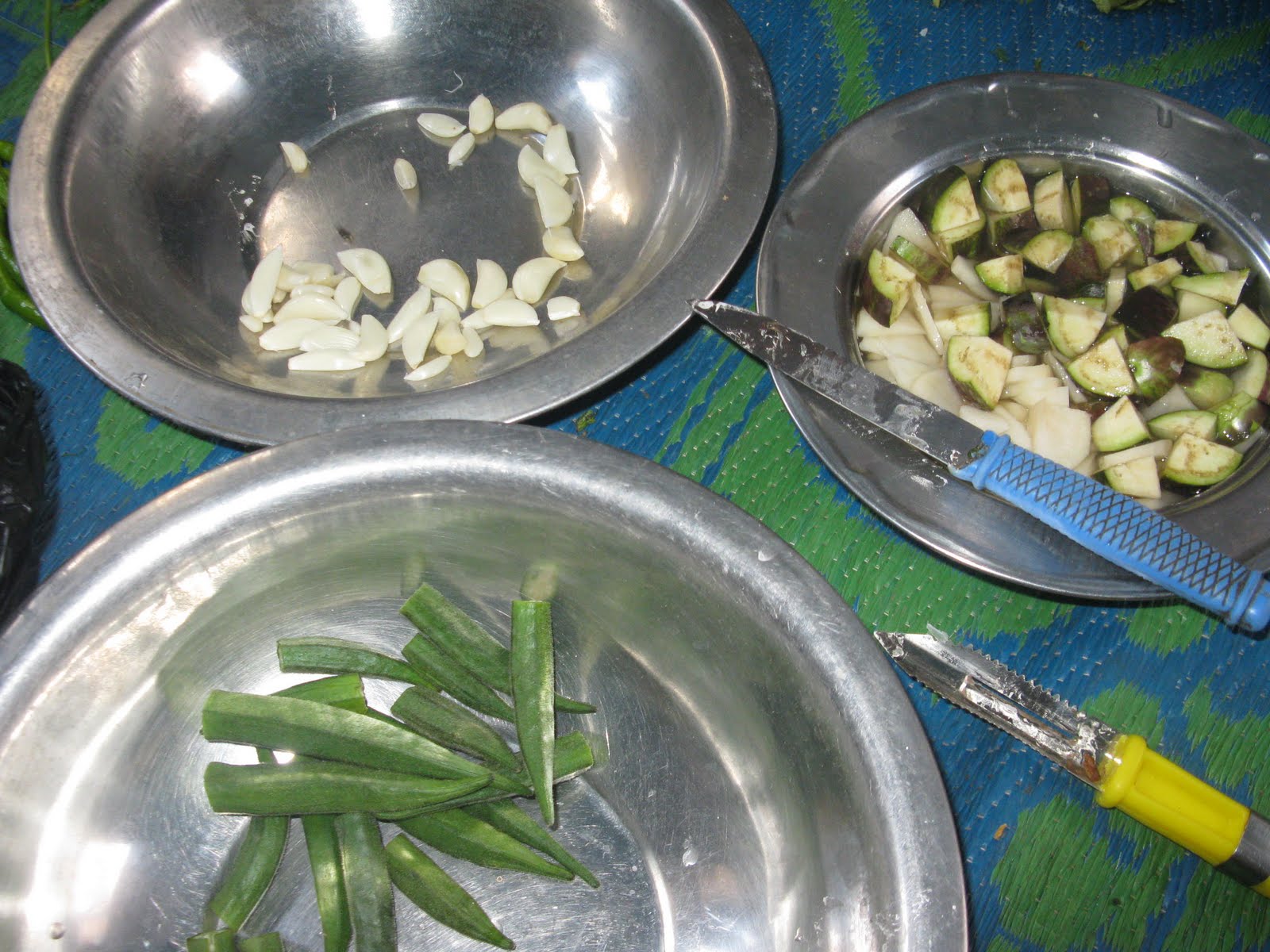
Mr. Rathore picks me up and we head to his home. Like most urban Indians they live in townhouses. I follow Mr. Rathore into the courtyard and am not surprised by what I see. The courtyard is run by cows. Mr. Rathore proudly shows them to me. They have one female and two calves. They get milk from them to make curd. “Plus they bring good luck,” Mr. Rathore states. We go upstairs and I meet the family: Kiran, the mother; Priyal, their daughter; and Rasheesh, their son. What's on the menu? A simple thali meal of tomato and eggplant curry, masala stuffed okra, dal, vegetable pakora, chapatti, puri, and pakothra, and, of course, masala chai. I can’t wait.
Okra, garlic and eggplant
I enter their apartment; it consists of two rooms. One is used by them to sleep and eat. The other is used to sleep and cook. In the first room there is a thin mat covering the concrete floor, we sit down side by side with the vegetables.  And so the cooking begins. Kiran peels and cuts everything in her hand. From her magic hands, potato peels fall to the floor and chunks fall in bowls. I'm not nearly as efficient and find it difficult to cut the vegetables without a cutting board.  Taking notice of my struggle, she puts me on garlic peeling duty with Priyal. While I crush garlic against the floor a "MooooOOHH," from the cow in the adjacent courtyard bellows in the room. Priyal and I giggle.

We chat and peel away. I drink chai with Kiran and she explains the recipes in Hindi while Priyal translates in English. If Priyal missed a step, Kiran is quick to scold her in Hindi and then correct in English. Kiran is a warm woman, but a stern mother. She insists that Rasheesh does his homework when he snoops on us. Priyal is a lovely young woman. At thirteen she knows she wants to be a teacher and plans to travel around India. I ask her if she wants to travel the world and she looks confused and replies, “No, I won’t travel the world. India is big enough and lots to see here, you know?” Yes, I do know. The vegetables are prepped and we move to the second room.  


Kiran picking cilantro leaves
The second room is crowded. There is a twin size bed which takes up most of the space. Kiran, Priyal and I have a small hallway of space between the bed and gas box burner. Cooking utensils emerge from under the stove and bed. Ingredients are kept on shelves built in to the concrete walls. They have no sink or running water so the dishes are cleaned in a big bowl. Water is poured from a traditional matka, a large clay vase.  I’m in awe of Kiran, as I see the two-burner gas box and the small space she has to prepare her family’s meals. 

Priyal and Rasheesh
Her ingenuity is artful. She uses a mortar and pestle to grind onion, garlic, chillies and spices into a masala paste. She uses the paste to flavour the eggplant and tomato curry and stuff the okra.  I help her make the paste and stuff the okra with it. We fry up the eggplant and tomato curry and put it in a bowl to rest. We use the same frying pan to cook the okra. “No space, no waste,” Kiran says firmly. Priyal smiles as she helps her mom. We use a pot to boil the lentils and, after a quick rinse, the same pot cooks the rice. We use flour, potato and cilantro to make a dough, and fry teaspoon size balls to make vegetable pakora. The same pan and oil is used to fry puri.
Vegetable pakora
Next we make the breads. One simple flour and water dough can make three breads. First, we make puri. We roll out a saucer size circle of dough, add some ghee on both sides and then deep fry it. It quickly puffs up and turns golden. Next, we make chapatti. We roll out another saucer size circle and then fry that without butter on the pan. It doesn't puff up but is still flaky inside and has nice dark spots on the outside. The last bread is pakothra. We roll out a saucer size circle but then fold it in half. Add some butter. Then fold it in a triangle. We roll it out so it looks like a rounded triangle. Add some more butter and then fry it on the pan. This one is flakier than the chapatti. All are delicious.
The never ending thali
Once our food is ready we had back to the first room. We set up plates for everyone and we eat Kiran’s food with our hands. Everything is delicious. It was finally my turn to impress the Rathores with how well I can eat with my hand. After eating, we drink chai and Priyal offers to paint my hand with henna. I agree and she creates a beautiful design. The cooking was great but it was the experience of being with an Indian family for an afternoon that was better.

The Taj Mahal

It's called the world's most beautiful building and a monument to love. What can one say about the Taj that hasn't already been said? I find words to describe this building meaningless; they fall short of capturing the graceful curves, strong marble, and eloquent lines of the building. The problem is you've seen the Taj many times: postcard perfect pics of it and the famous Princess Diana pose. In spite of this, the building is still stunning.

Here are some interesting facts about the Taj Mahal. The Mughal Emperor Shan Jahan built the mausoleum for his third wife, Mumtaz Mahal. Unfortunately, he was jailed in nearby Agra Fort by his son where he overlooked the masterpiece from his cell until his death. Another interesting fact about the Taj is that it has surprisingly great acoustics. To impress the tourists, Taj tour-guides sing or say 'hello' which echo up the famous marble dome.

I'm going to keep this post short and let the pictures do the talking, but I will tell you we woke up early to visit the Taj at sunrise. The early morning light cast the building in a golden light and then highlighted the white marble. Here are the pics for you to enjoy!

Our first look of the Taj from a roof-top restaurant in Agra

A panel of Urdu script on the Taj


Sun-rise view of the Taj from the right side

Inside the Taj's mosque

The one and only Taj Mahal

View from Agra Fort

Friday, 22 April 2011

South Indian Food


Most of us are familiar with North Indian foods; they are curries like palek paneer, aloo gobi, mutton masala, butter chicken and tandoor favourites such as tandoori chicken and naan bread. These are the international representatives for Indian food, but the Southern states have great dishes that have fast become my new favourites. 

A big difference between North and South Indian cuisine are the foods on offer at breakfast. South India has many different items served specifically as breakfast or snack foods. Here are some items we ate at breakfast:
Dosas
The best description is a savoury crunchy crepe stuffed with fillings like potato, onion and tomato. This particular item is usually served at breakfast but can also be for dinner. My favourite is the masala dosa. A thin crispy crepe stuffed with masala flavoured potatoes.


Wadas and Idllis
These are standard breakfast or snack fare. The wada is a crispy donut that you dip in a thin curry lentil soup and coconut chutney. The idlli is a thick crumbly doughy pancake. It is also served with soup and chutney.

Uthappams
Although they sound like a Roald Dahl character they are actually another delicious breakfast or snack food in the South. Friends in Korea might recognize this because it is very similar to a Korean dish called pajeon.  Uthatppams are a savoury pancake. Cooked until one side is really crisp, it can come with a variety of fillings like onion, garlic and onion, onion and tomato. It is also served with a curry and coconut chutney.


Interestingly, these items don’t always come with utensils. Andrew and I had to learn how to use our right hand (only) to eat them. The trick is using the plate to help you tear pieces off. Using your index finger and thumb pushing against the bottom of the plate you’re able to break apart the food quite efficiently. Eating with your hands seems to be more common in the South than in the North

Sambar
A delicious curry soup that has a bit more bite than its Northern counterparts. We tried Sambar in Kerala, it was tangy, sour and full of curry flavour. A nice tingly heat lingered on the tongue. But it was nothing our vegetable raita couldn’t cool down. 

Bread
When I first got to India I was  looking forward to eating naan everyday. But I quickly learned that naan isn’t as popular down South as it is up North. The tandoor, the oven used to cook naan, is traditionally used in the North. Instead South Indians prefer the above breakfast items or other breads like the deep-fried flaky goodness of a puri, a simple bread made from flour, water and salt that gets deep fried to a golden bite-size portion. It sounds almost better than naan, right? Well, it’s a close second.

Saturday, 19 March 2011

The Best Bite: Mysore Pak

I'm in love. Thalis, curries and dosas they’re all delicious, but I have a sweet tooth. India has won me over with its incredibly rich and buttery sweets.
Two weeks ago I was in Mysore. Mysore has a nice palace, an okay hill, and a ho-hum train museum which is described as a “must see” in the guidebook—one good train display and three old engines a must see does not make. As far as I’m concerned, the only reason to visit Mysore is to eat Mysore Butter Pak the local sweet. But I’m biased. Andrew who doesn't have a sweet tooth agrees with me.
Here are the ingredients: ghee (clarified butter), flour, sugar. Finished. Who knew three simple ingredients could make such a delectable creation? This sweet starts off with a crumbly edge. After the crumbly edge a delicate gooey center appears and melts away leaving a mild buttery sweetness in your mouth. It's rich. A small square is almost too much to eat. Almost too much.
We were chatting with some travelers and asked if they tried it. Looks of guilt blushed on their faces as they meekly replied: “Yes, last night for dessert and then again this morning for breakfast.” I didn’t judge them because I’ve been guilty of gluttony far worst then that and Mysore butter pak is worth every single calorie!